Day 1
– 3PM
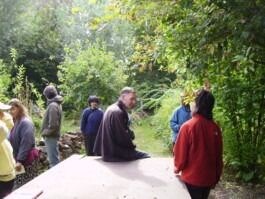
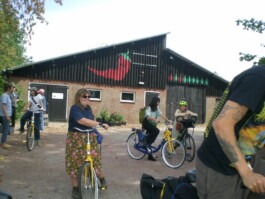
We arrive at Plaats De Kleine Aarde in carpool groups, one after another.
We’ve hit the jackpot: a true commons summer school crossover with the Schumacher International Summer School.
Their days at De Kleine Aarde began with everyone singing a song together. To celebrate this serendipitous overlap, we sing along with them.
– 4PM
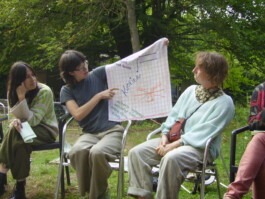
With a glass in our hand, containing an apple juice ice cube which is slowly melting—revealing the apple seed at its core—we have a conversation about summering, freezing, hanging out, sun hours and care wealth (the rich ecosystem of unpaid or gifted care that enables people to live well; emotional support, community meals, skill-sharing, gardening) with Lenn Cox and Rosanne van Wijk from the z o m e r e n collective.
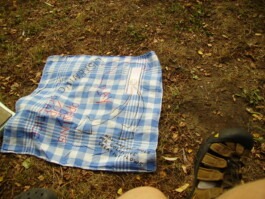
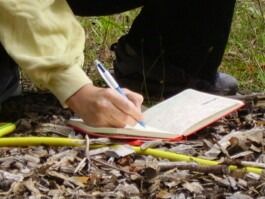
We create “making time / giving energy” dish towels, on which we each write an offer and a request, as an action verb of intention for this collective project.
– 6PM
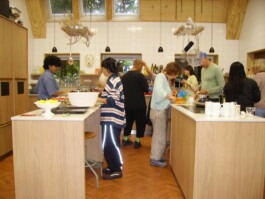
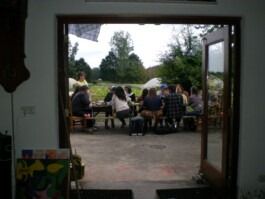
The cooking skills offered on the tea towels are immediately put to the test in the form of a 5-star meal, improvised with the entire group, which definitively disproves the saying “too many cooks spoil the broth.”
Day 2
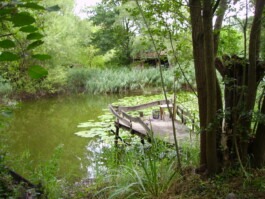
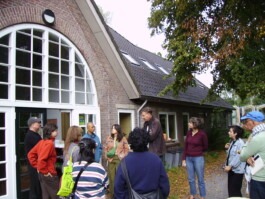
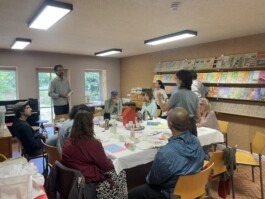
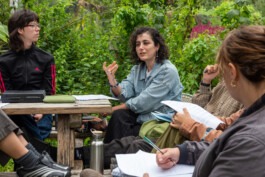
Wouter then tells us about Platform DIS and how the organisation came into being, what they do and their philosophy of inter-connectedness with the more-than-human.
Day 3
– 11AM
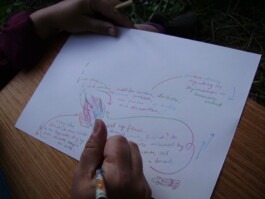
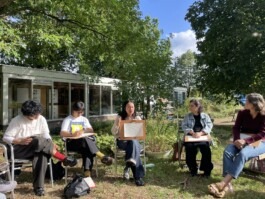
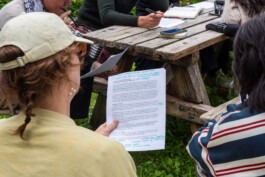
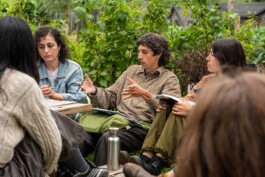
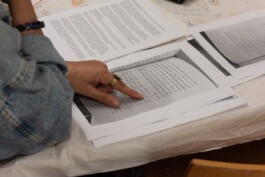
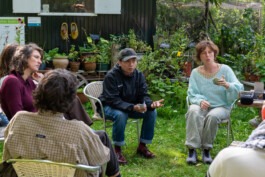
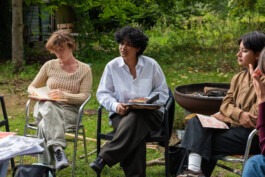
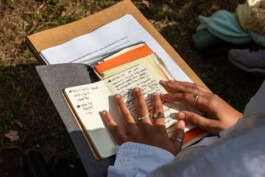
Hilda Moucharrafieh, co-director of Platform BK translated the essay ‘Freedom of Thought and Expression’ by the Palestinian thinker, teacher and author Munir Fasheh into English on the spot, using pen and paper. We took turns reading lines from the essay – part of the as yet untranslated book *على طريق الحكمة - تأمّلات في المعاني المختلفة للتعلّم* – during a focused session in the garden of Plaats de Kleine Aarde, whilst Hilda revealed the poetry behind the Arabic translation of the words as we went along.
Munir Fasheh (1941) is a theorist and practitioner in the field of learning; he taught mathematics and physics and, during the first Intifada, founded the Tamer Institute for Community Education in Ramallah, a centre for the development of learning environments outside the formal school system in Palestine. ‘Freedom of Thought and Expression’ touches upon, amongst other things, freedom of speech and the liberation of our thoughts, as well as the difference between education and learning.
– 1PM
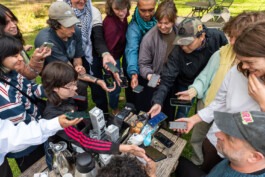
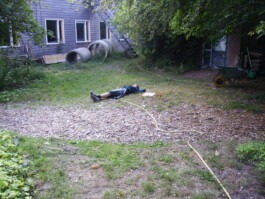
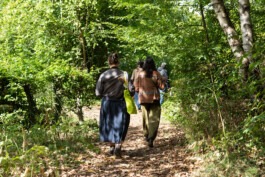
Reza Afisina, new media artist and member of Ruangrupa artist collective introduces us to an improvised style of radiomaking, using our mobile phones – pieces of high-quality technology that almost all of us carry on a daily basis. The assignment is clear:
Once you’ve completed these steps, do it again: listen, record, delete. After the third time, keep the recording. Then return to the group.
– 2PM
The Irish music session at Plaats DKA starts.
The act of listening, recording and deleting the audio file makes us aware of constant changes and unpredictability of the sounds around us, though some of us are quite frustrated about having deleted our best recording.
We play back all our recordings at the same time and a beautiful soundscape capturing the moment arises.
– 4PM
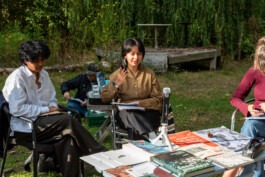
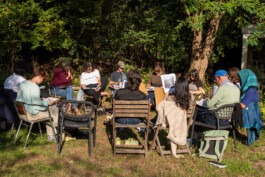
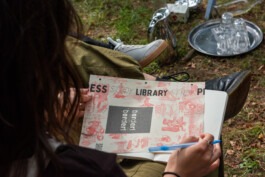
border!border! hosts a joint reading session of two texts and tell us about their work of preserving and making available subcontinental theory and literature through a shared (online and physical) library, publishing house and archiving network.
The texts teach us about foraging practices and land commoning in different areas of India, about the caste system and revolutionary feminist farming initiatives fighting the system locally.
Day 4
– 2PM
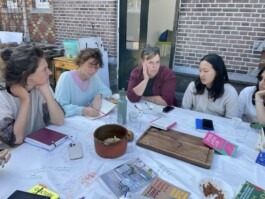
We arrive at Clublokaal and prepare lunch together. It takes a bit of getting used to the small kitchen but we make it work. Everyone has brought along a book or text they would like to introduce to the group.
– 4PM
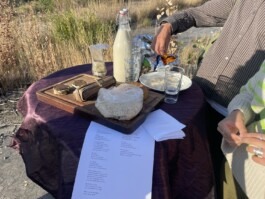
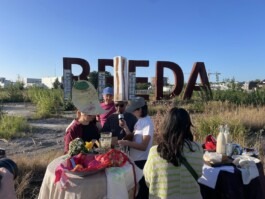
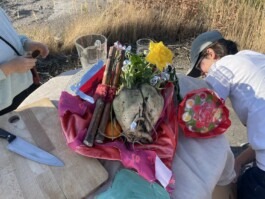
Within an hour and a half, we collectively put together a wedding ceremony, costumes, food and drink, a marriage certificate and a karaoke-style wedding song, for the sugar beet (sourced from a local farm in the Netherlands) and sugar cane (brought from Indonesia by Arie Syariefudin, artist and member of Jatiwangi Art Factory). We move the whole ordeal to ‘T Zoet, where the CMS sugar factory used to be and where the party will take place.
The wedding marks the beginning of our collaboration, and of a collective exploration into the local and colonial history of sugar production in the Netherlands and in Indonesia, a subject Arie has focused his research on, since getting in touch with Guido Zuur, the great-grandson of the owner of the former sugar factory in Jatiwangi, where Jatiwangi Art Factory is situated.
It is a wonderful celebration, and we are all impressed by how quickly one (or all) can organise a full-blown wedding.
Day 5
– 10 AM
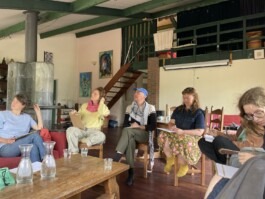
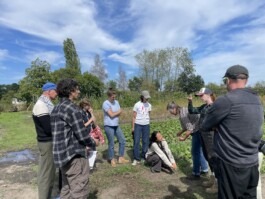
Vanya ter Veld (programme maker, educator and writer) welcomes us at Sofia’s Tuin to join an Impossible Conversation by Building Conversation, which Vanya is a part of. We are asked to think of a collaboration that didn’t go smoothly. Some write down very personal experiences, others share about a professional collaboration or a distant memory. By hearing everyone read their own text, we are offered an intimate glimpse into each other’s minds. After a few days of knowing each other, we are capable of sharing a lot with the group. The second round reveals what was going on in the minds of the others just a few minutes before, as everyone was asked to respond to the texts that were read. Then quite suddenly, the conversation was over; what else was there to say, now that all this had been laid bare?
– 1 PM
Tour of Sophia's Tuin by the farmers, Vincent, Ingrid and Raisa. They share their inspiring story of buying back the land for the people, farming and sharing the produce. The collaboration between the inheriters of Seters - the land on which the farm is located - artists, the farmers and volunteers is a special one and everyone is bursting with questions.
Day 6
– 1 PM
We look back on the past week. How did everyone experience it? What did we think of the various workshops, initiatives, and the overall experience? In a short time, the group has quickly become comfortable with one another, setting the stage for a warm and lively working period. It’s a shame it’s already over!
– 3 PM
Dewi Sofia, … and … from Balik/bayan, an activist collective of cultural workers united around the Filipino diaspora, tell us about organizing collectively as an activist collective, the intrinsic connection between art and activism, and the historic Filipino resistance movement of which they are a part. How do you keep the fire burning?
– 5 PM
Hilda Macharouchiaffeh and Arthur Kneepkens, co-directors of Platform BK, share their insights on unions, forming alliances, and mutual support among arts and culture workers. We’ll also read and discuss a passage from the new book *Goodbye Poverty Jetset* by Sepp Eckenhausen.
– 8 PM
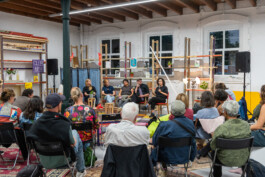
We wrap up the final day of the summer school with a discussion on a timely topic for Clublokaal: art and the commons in Breda: Is Art Allowed to be Controversial? Art and artists are not separate from their (local) environment and the political climate that prevails there. Clublokaal experienced this firsthand through criticism from the VVD and Mayor Depla regarding the closing performance of (un(h)armed, an exhibition about the increased militarisation in the Netherlands. During the talk, we delved deeper into artistic freedom and to what end it is used. The evening simultaneously formed the launch of STOOM (Standing TOgether Opposing Militarism), the collaborative campaign for art workers against militarisation and budget cuts.